Choosing the right motor grader in Nigeria requires more than comparing engine power and purchase price. The machine must suit the road material, workload, terrain, rainfall and maintenance resources of the project.
A correctly matched grader can improve road shape, drainage and daily productivity. An undersized machine may struggle with hard material, while an unnecessarily large grader can increase fuel and maintenance costs.
This guide explains the main specifications to check when selecting a motor grader for highways, rural roads, municipal projects or mining roads in Nigeria.
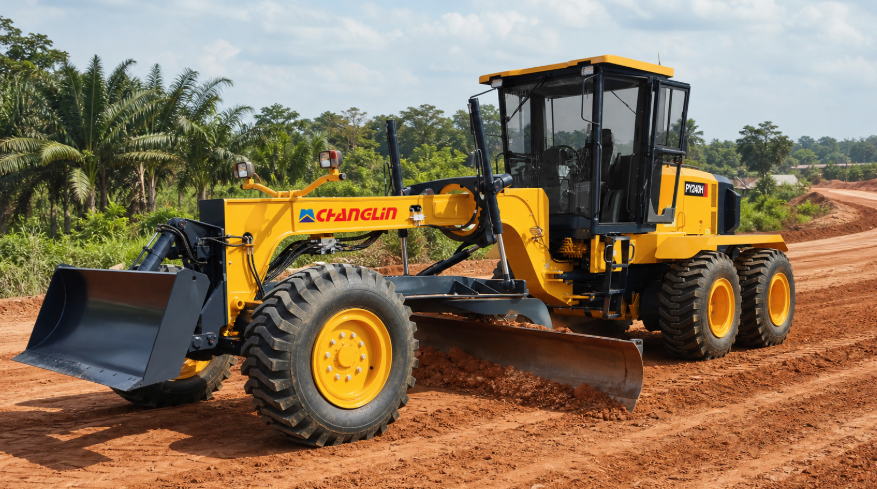
A grader used for routine maintenance of laterite roads does not require exactly the same configuration as one working on a highway or mining haul road.
Before requesting a quotation, define:
New construction or road maintenance
Soil, laterite, gravel or crushed-rock conditions
Required grading depth and finished width
Expected daily operating hours
Site gradients and turning space
Rainy-season requirements
Available operators and maintenance support
This information helps the supplier recommend a suitable machine instead of quoting a standard configuration without understanding the project.
Buyers looking for a motor grader for sale in Nigeria often compare horsepower first. However, engine output should be evaluated together with operating weight, traction and low-speed control.
A lighter grader may suit rural-road maintenance, light reshaping and smaller construction sites. A heavier and more powerful machine may be more suitable for highway formation, hard material, deep cutting and mining roads.
More power is not automatically better. A powerful engine cannot deliver its full value if the machine lacks traction or is too large for the site.
Ask the supplier to compare:
Engine output
Operating weight
Drawbar pull
Weight distribution
Working speed
Fuel consumption under the expected load
The correct choice is the machine that meets the production target at a practical operating cost.
The moldboard, or grader blade, is the machine’s main working tool. Its size and movement range determine how efficiently the grader can cut, spread and shape material.
When checking motor grader blade size, compare:
Blade length and height
Maximum cutting depth
Lift above ground
Side reach
Blade rotation range
Cutting-edge material
Availability of replacement edges
A wider moldboard can cover more surface per pass, but it requires suitable power, stability and working space.
For Nigerian roads, the grader should also be able to form a consistent road crown and reshape shoulders. These operations direct rainwater away from the carriageway and help protect the road base.
A motor grader with ripper can loosen compacted soil or old road material before the blade reshapes it.
A rear ripper may be useful for:
Rehabilitating compacted laterite roads
Breaking hard road surfaces
Preparing mining access roads
Reducing reliance on another machine for light ripping
The grader must have sufficient power, frame strength and traction for the attachment. Buyers should specify the expected ground conditions, number of ripper shanks and required working depth.
If the project mainly involves light maintenance and surface finishing, a ripper may add unnecessary cost.
Effective drainage is as important as surface smoothness on many Nigerian road projects.
Heavy rainfall can quickly damage an incorrectly shaped road. Standing water can soften the base, create potholes and erode the shoulders.
A suitable grader should be able to:
Form a consistent road crown
Cut and maintain side drains
Reshape shoulders
Spread replacement material
Correct ruts before they deepen
Work steadily on soft surfaces
Precise blade control at low speed is important. The operator should be able to make small adjustments without creating waves or removing too much material.
Tyres should also match the site. The appropriate tread depends on whether the machine will work on prepared roadbeds, loose laterite, gravel or muddy access roads.
Grading quality depends on steady movement, accurate controls and reliable hydraulic response.
When comparing machines, review:
The transmission should provide enough low-speed choices for fine grading and suitable travel speed between work areas. Ask about forward and reverse gears, gear-shifting method, differential lock and transmission protection.
The hydraulic system should allow smooth adjustment of blade height, angle and side shift. Check pump configuration, system pressure, hose protection, oil cooling and access to filters and seals.
Frame articulation, front-wheel steering and wheel lean improve manoeuvrability around curves, junctions and drainage channels. Compare turning radius, articulation angle, stability and visibility of the blade.
These systems should be evaluated together. Strong engine power alone cannot compensate for poor control or unsuitable traction.
The lowest purchase price does not always provide the lowest lifetime cost.
A complete comparison should include:
Fuel consumption per working hour
Expected output per shift
Maintenance intervals
Filter and lubricant requirements
Tyre and cutting-edge costs
Ripper-tooth replacement
Access to service points
Warranty and technical support
Before importing a machine, prepare an initial motor grader spare parts package. It may include filters, seals, belts, hoses, cutting edges, ripper teeth and other recommended wear parts.
The package should reflect the planned operating hours and actual machine configuration. A generic list may include unnecessary parts while missing items that are important for the project.
A motor grader rarely works alone. A typical road project may also require an excavator, wheel loader, bulldozer, road roller, water tanker and dump trucks.
For example, a wheel loader places material, the grader spreads and shapes it, a water tanker adjusts moisture, and a roller completes compaction.
Selecting the equipment as a coordinated fleet can reduce waiting time and improve production. Dingsheng Tiangong can support project-based selection when a buyer needs several types of road construction equipment in Nigeria.
A standard machine may be sufficient for common projects. However, an OEM motor grader or ODM configuration may be valuable when the buyer has special operating, branding or tender requirements.
Useful options may include:
Rear ripper or front scarifier
Alternative tyres
Enhanced cooling
Air-conditioned cab
Work lights and rear-view camera
ROPS/FOPS protection
Custom branding and operating labels
Tender-specific documentation
Project-specific spare-parts package
Customization should solve a genuine project requirement. Unnecessary options increase cost and may complicate maintenance.
Backed by SINOMACH manufacturing and engineering resources, Dingsheng Tiangong supports OEM, ODM and special working-condition solutions for international customers.
The Dingsheng Tiangong PY240H is an example of a heavier grader platform for demanding road and earthmoving applications.
Its published specifications include:
20,000 kg operating weight
179 kW rated engine output
4,420 mm moldboard
Maximum grading depth of 500 mm
Six forward and three reverse gears
Articulated frame
These figures do not mean the PY240H is suitable for every project. The buyer should compare them with the road material, required output, working width, attachments and transport limits.
The purpose of technical selection is to find the correct configuration, not simply the largest available machine.
Before confirming an order, verify:
Does the machine match the road material and workload?
Are the power, weight and traction appropriate?
Is the moldboard suitable for the required road width?
Is a ripper or scarifier necessary?
Can the grader form crowns, shoulders and drains?
Are tyres and cooling suitable for the site?
Are manuals, wear parts and initial spares included?
Are the warranty, configuration and delivery terms written clearly?
There is no single best size. Rural-road maintenance, highway construction and mining roads require different levels of power, weight and attachments.
No. Horsepower should be evaluated together with operating weight, traction, transmission, hydraulic control, moldboard size and fuel consumption.
Yes. Depending on the manufacturer, customization may include the ripper, tyres, cooling, safety equipment, labels, spare parts and tender documentation.
The right motor grader in Nigeria should match the road material, project scale, drainage requirements, working hours and maintenance plan.
Send Dingsheng Tiangong your road type, soil conditions, required grading width, expected output and preferred attachments. Our team can coordinate machine selection, OEM or ODM configuration, production, inspection, documentation and international delivery.
Contact Dingsheng Tiangong for a project-specific motor grader recommendation and quotation for your highway, rural-road, municipal or mining-road project in Nigeria.
 EN
EN
 AR
AR
 FR
FR
 DE
DE
 IT
IT
 PT
PT
 RO
RO
 RU
RU
 ES
ES
 TL
TL
 LV
LV
 LT
LT
 UK
UK
 VI
VI
 BN
BN
 LA
LA
 MY
MY
 KK
KK